
About the Websites Symbolism
About the Star and Symbol
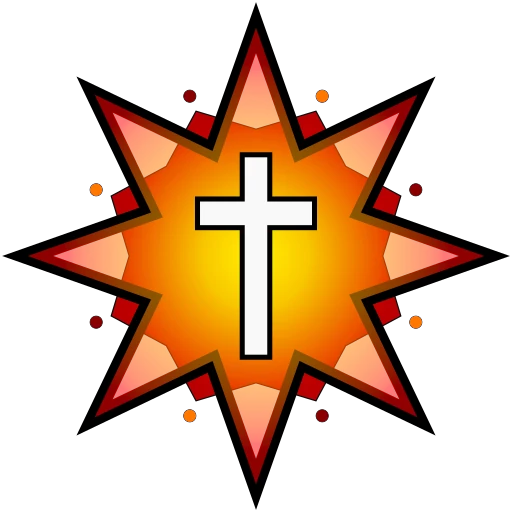

I needed a general symbol, logo, and/or icon to use across my various websites.
It seems that nowadays, any symbol—no matter how benign or godly—might be accused of having pagan or occult origins. So I chose the least controversial symbol I could find.
I chose the 8-pointed Star of Bethlehem and the White Cross of Christ.
The 8-Pointed Star
This star can represent many things: the Birth of Christ, His Divinity, the Seal of Melchizedek, the Star of Saint John, Christ’s Resurrection, the Star of Redemption, the Kingdom of God, and eternity. It is sometimes called the Star of Christ.
In the Holy Bible, the number 8 often represents holiness to God. It can symbolize: Holiness to the Lord, New Birth, New Creature, Born-Again, Salvation, Regeneration, Resurrection, New Beginning, Circumcision of the heart, and Deliverance.
There are 8 circles beyond the points of the main star—4 lighter and 4 darker. These circles represent eternity. The star itself reflects the four cardinal directions—everywhere. The 4-pointed star is also often used to represent both the Star of Bethlehem and the Cross of Christ. As a child, I would draw the 4-pointed star above the manger.
The 4 lighter circles represent:
- Hope, grace, illumination, and the presence of God.
The 4 darker circles represent:
- Trials, refinement, repentance, and the hidden mysteries of faith
The White Cross of Christ
At the center of it all is the White Cross of Christ, representing purity, holiness, sanctity, and innocence. But this cross has endured everything: death, sin, blood, purification, and resurrection. It has transformed from a symbol of shame into a symbol of triumph and glory.
When I was a child, I would draw the Star of Bethlehem with either 4 or 8 points. The bottom point always pointed to Jesus—specifically to His birth, to the manger. But Jesus is in heaven now, and His Spirit is always with us. So it seems fitting that the star’s points now represent all directions—because God is everywhere.
Color Symbolism
The colors I use vary depending on the background. But generally:
- Red and Orange: Represent fire, as in God's Baptism.
- Blue: Represents Israel.
✡️ Why I Didn’t Choose the Six-Pointed Star
While the six-pointed star—often called the Star of David—is widely recognized today as a symbol of Judaism, I chose not to use it for this project. My intention was to create a symbol that reflects the birth, life, death, resurrection, and eternal reign of Jesus Christ, and I wanted to avoid confusion or unintended associations.
The six-pointed star has deep historical and cultural significance, but it is not directly tied to the Gospel message or the person of Christ in Scripture.
In contrast, the eight-pointed Star of Bethlehem has long been used to represent:
- The birth of Christ
- His divinity and resurrection
- The Kingdom of God
- The Seal of Melchizedek
- The Star of Redemption
In fact, in ancient biblical manuscripts such as the Leningrad Codex, the eight-pointed star is used in decorative and symbolic contexts—often preferred over the six-pointed star in sacred Christian art and iconography. This historical precedent affirms its spiritual resonance and theological alignment.
This is a page from the Lennigrad Codex, showing the six and the eight pointed star. The Leningrad Codex (Codex Leningradensis) is the oldest complete manuscript of the Hebrew Bible in Hebrew.

The animation is to help show the Hebrew text underneath.
Concerning the banner at the bottom:
Repeated across the top of the banner is the Name of God in Hebrew. The first is in Ancient Pictographic Hebrew. The second is in Paleo-Hebrew script, also known as Proto-Hebrew. And the third is God's Name in Modern Hebrew.
Concerning the Hebrew: the meaning of my full name is “The Noble Angel of God’s Grace.” I put that into Google Translate, it comes out in Hebrew as "המלאך האצילי של חסד אלוהים”
"Angel" could also be interpreted as "Messenger, Interpreter, or Intercessor" (it's all the same word) and the meaning of my family name.
About the Three Praying Angels


Wondering about the three angels in the bottom right corner of every page?
They represent three happy children I saw in heaven—each holding onto my right arm:
- The oldest, with blonde hair, held onto my wrist.
- The second, with brown hair, held onto my forearm.
- The youngest, with red hair and a radiant smile, held onto my elbow.
I believe they were my granddaughters—yet to be born, yet to die—but already known to God.
They are depicted in various ways as Faith, Hope, and Charity.
Their real names are: Juana, Luna, and Milagro Rosa.